
Note
Go to the end to download the full example code
Complex EOF analysis#
In this tutorial, we’ll walk through how to perform a Complex EOF analysis on the zonal and meridional wind components.
Let’s start by importing the necessary packages and loading the data:
import matplotlib.pyplot as plt
import xarray as xr

import xeofs as xe

xr.set_options(display_expand_attrs=False)
<xarray.core.options.set_options object at 0x7e85b3262450>
For this example, we’ll use the ERA-Interim tutorial dataset eraint_uvz:
uvz = xr.tutorial.open_dataset("eraint_uvz")
uvz
This dataset contains the zonal, meridional, and vertical wind components at
three different atmospheric levels. Note that the data only covers two months,
so we have just two time steps (samples). While this isn’t enough for a robust
EOF analysis, we’ll proceed for demonstration purposes. Now, let’s combine the
zonal (u) and meridional (v) wind components into a complex-valued
dataset:
Z = uvz["u"] + 1j * uvz["v"]
Next, we’ll initialize and fit the ComplexEOF model to our data. The
xeofs package makes this easy by allowing us to specify the sample
dimension (month), automatically performing the Complex EOF analysis
across all three atmospheric levels. As a standard practice, we’ll also weigh
each grid cell by the square root of the cosine of the latitude
(use_coslat=True).
model = xe.single.ComplexEOF(n_modes=1, use_coslat=True, random_state=7)
model.fit(Z, dim="month")
/home/nrieger/miniconda3/envs/xeofs/lib/python3.11/site-packages/scipy/sparse/linalg/_eigen/_svds.py:483: UserWarning: The problem size 2 minus the constraints size 0 is too small relative to the block size 1. Using a dense eigensolver instead of LOBPCG iterations.No output of the history of the iterations.
  _, eigvec = lobpcg(XH_X, X, tol=tol ** 2, maxiter=maxiter,

<xeofs.single.eof.ComplexEOF object at 0x7e85b3299950>
Instead of just extracting the complex-valued components, we can also get the amplitude and phase of these components. Let’s start by looking at the amplitude of the first mode:
spatial_ampltiudes = model.components_amplitude()
spatial_phases = model.components_phase()

spatial_ampltiudes.sel(mode=1).plot(col="level")
plt.show()
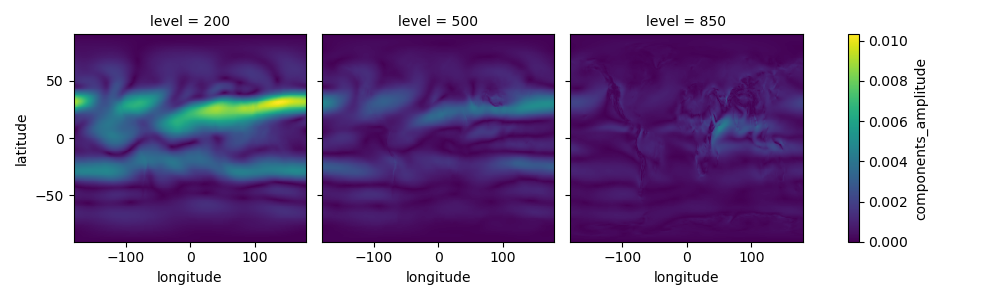
It looks like the first mode picks up a pattern resembling the location of the subtropical jet stream around ±30º latitude, particularly strong in the upper troposphere at 200 hPa and weaker toward the surface. We can also plot the phase of the first mode. To keep the plot clear, we’ll only show the phase where the amplitude is above a certain threshold (e.g., 0.004):
relevant_phases = spatial_phases.where(spatial_ampltiudes > 0.004)
relevant_phases.sel(mode=1).plot(col="level", cmap="twilight")
plt.show()

Total running time of the script: (0 minutes 1.180 seconds)